
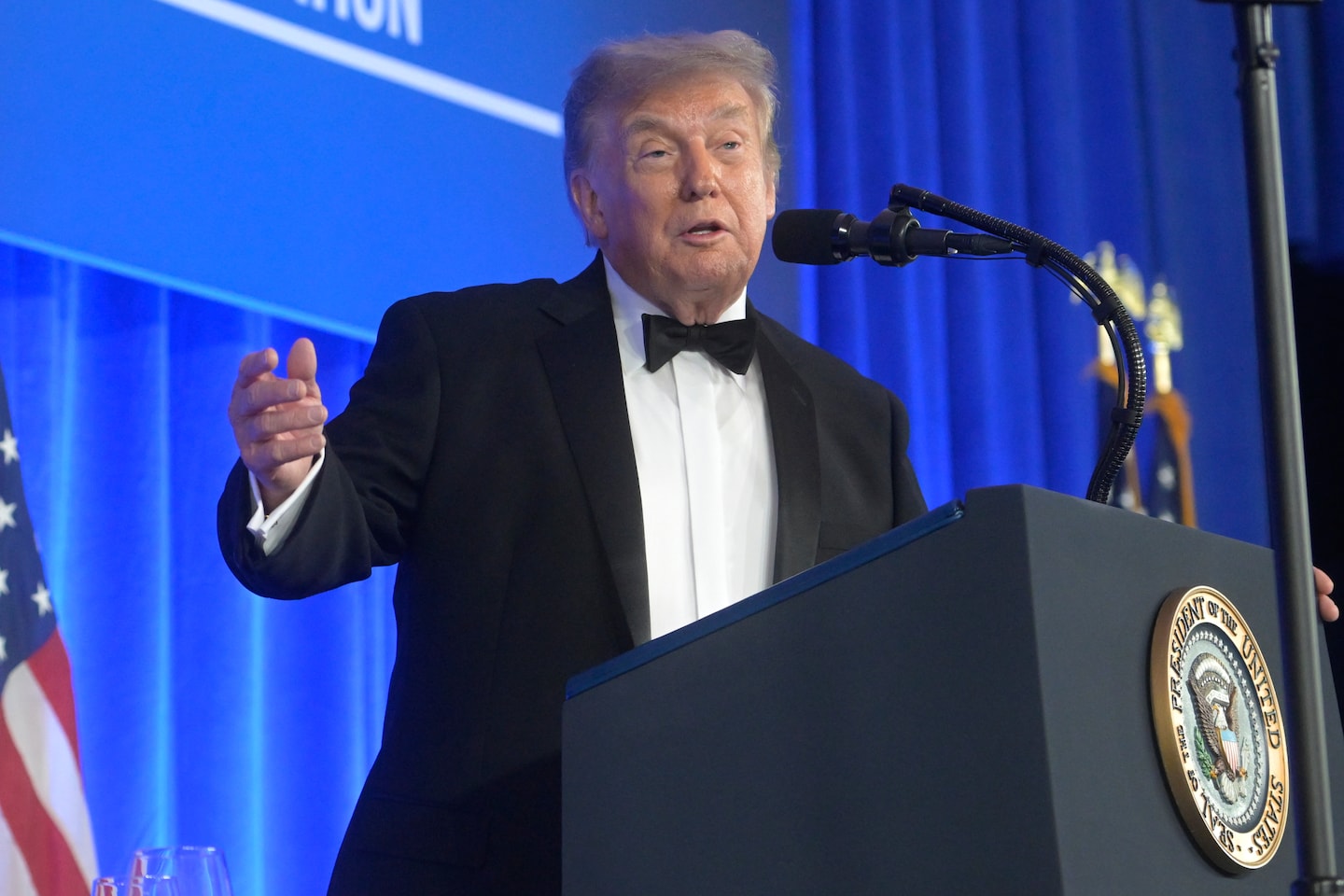
The president addressed a smaller, heavily secured gathering Friday as his administration intensifies its legal and rhetorical attacks on journalists.
President Donald Trump attacked a slew of journalists and some of his favorite political foils at a slimmed-down redo of the White House correspondents’ dinner on Friday, comparing one female reporter to a transgender social media star, mocking politicians’ physical appearances, and bringing his audience to mostly stunned silence for more than an hour before pulling out a red Trump 2028 cap and declaring he was running for another term.
Three months after a gunman exchanged fire with authorities outside the first correspondents’ dinner, throwing the event into chaos, Trump addressed reporters even as he embraced an aggressive stance that favors targeting journalists to root out leakers in his administration.
Trump veered on and off his prepared script for the evening, at one point calling it a “fricking stupid speech.”
The fraught event put the president on the dais with reporters who have covered him aggressively. Trump rarely speaks to audiences that aren’t packed with his supporters, leading to an unusual dynamic in a ballroom of reporters who are professionally bound to maintain poker faces.
Some of his first jokes drew laughs, including one that acknowledged the interrupted first run of the meal.
“I hope that everyone finally got to enjoy their entire, very delicious beef tenderloin, very special beef. And I want you all to know that Bobby Kennedy, who’s right here, personally ran over the cow with his car,” he said.
President Trump jokes about Health and Human Services Secretary Robert F. Kennedy Jr. at the White House Correspondents’ Dinner: “I want you all to know that Bobby Kennedy ran over the cow with his car.” pic.twitter.com/jvOHrJH19n
— CSPAN (@cspan) July 25, 2026
But the tone quickly shifted to a far more caustic attack on his favorite foils, including some of the reporters in the room. The bitterness was sharper even than some of his political rallies, where attacks on his enemies are leavened with boasts of his accomplishments. On Friday, he had little to sell, and a lot to complain about.
He said that he had once mixed up CNN reporter Kaitlan Collins, whom he said “never smiles,” with a transgender social media personality, Dylan Mulvaney, after he called the 34-year-old cable news star a “young, attractive woman.”
He said he planned to host twice-weekly fights at the White House.
“We will have sloppy Chris Christie, one of the sloppiest human beings, fighting,” Trump said to silence. “I could mention the governor of Chicago, but I’m going to mention instead Jerry Nadler. Oh my God! They’re fighting for a big piece of cheesecake, big fat piece of cheesecake.”
Then he told a joke about Sen. Adam Schiff (D-California).
“I hate some people,” he said to groans. “He’s a liar, and I called him watermelon head because he has the largest head I’ve ever seen with the smallest neck, pencil neck. How does that make a fat, ugly head on a little pencil neck?”
Commerce Secretary Howard Lutnick laughed at that one, putting his hand on his forehead.
“This night is all about the First Amendment. Tonight was a full display,” CBS chief White House correspondent Weijia Jiang said after Trump finished talking. As the outgoing president of the White House Correspondents’ Association, Jiang led the event. She complimented Collins and a Wall Street Journal reporter whom Trump also attacked during his speech.
The speech took place as the administration has stepped up its legal pursuit of journalists who report on subjects that the White House views as national security threats, with Trump saying Friday that he believed journalists were legitimate targets for investigation.
A federal judge offered a withering takedown a day earlier of the Justice Department’s effort to subpoena New York Times journalists over their reporting about security concerns around a new, Qatari-gifted Boeing 747 the president has been using as Air Force One. Trump was unrepentant.
“We’re not after journalists. We’re after leakers. We’re after people that are cowards, people that are unpatriotic, people that are treasonous in many cases,” Trump said in the Oval Office a few hours before the correspondents dinner. “And the way you find them is through the journalists. When the journalists probably know they shouldn’t write, they shouldn’t be giving information out like that.”
He said that even though the Justice Department withdrew the subpoenas on Thursday, “we have a long way to go with that case,” suggesting that the New York Times reporters’ legal peril was not over.
Trump had offered mixed messages about his plans for a dinner that traditionally has involved presidents giving lighthearted speeches that poke fun at themselves and at the people who cover them.
In the event, he offered a mix of barbs directed at the press and his political opponents, with a few toward his own administration.
“We’ll do a little ripping, if you don’t mind,” he said, saying that “this place is the really largest group of Trump derangement syndrome people ever put together at one time.”
He said that the speech he had originally planned to deliver, “I’m telling you, I had something. I was going to go after you.”
Media critics have long questioned the White House correspondents’ dinner, which was first held in 1921, saying that it is an overly cozy moment of socializing between the president and reporters who cover the White House. Trump skipped the event during his first term.
Trump acknowledged that Friday’s speech was his first to the annual dinner. And he joked that he didn’t plan to do it again, unless the event was renamed the “Trump White House Correspondents’ Dinner” — a line he delivered with a chuckle, before later saying that he planned to come next year.
Trump came to the dinner once before, as the guest of The Washington Post during the Obama administration. President Barack Obama mocked Trump that year over his questioning of Obama’s citizenship. Many analysts have credited that moment with sparking Trump’s decision to run for president, but Trump said Friday that wasn’t true, and that he had enjoyed the moment because of all the attention.
Before the president took the stage, he was confronted with reporters whom he has attacked and who have won awards for aggressive coverage of his administration.
He greeted one of the lead Associated Press reporters who was kicked out of the White House press pool because the outlet refused to relabel the Gulf of Mexico to Trump’s preferred “Gulf of America.”
He shook the hands of a team of Wall Street Journal reporters who won an award for their coverage of his connections to convicted sex offender Jeffrey Epstein. He shrugged his shoulders and smiled as CNN anchor Wolf Blitzer recounted how he had sued the Journal for $20 billion and how one reporter was forced to relocate her family because of threats against them.
Then he greeted Tyler Pager, a New York Times reporter who was served with a subpoena this month for his coverage of security issues around Air Force One.
Leading journalism professional groups, including the Society of Professional Journalists, called this week for the White House Correspondents’ Association to use the dinner to condemn the Trump administration’s attacks on journalists.
“We believe it is hypocritical to celebrate the First Amendment in front of the man who relentlessly attacks it,” the groups said in an open letter that was organized by two former ABC journalists and also signed by more than 520 mostly retired individual journalists.
Trump never delivered the speech he planned for the April 25 dinner at the Washington Hilton before it was interrupted by a gunman who attempted to storm the basement ballroom where the dinner was being held. Cole Tomas Allen, 31, has been charged with attempting to assassinate the president, and an FBI special agent said in an affidavit that Allen had set an email to be sent to friends and family with “targets, prioritized from highest-ranking to lowest.”
Trump acknowledged the risks around the event, saying that “it was not easy finding shoes to go on with your bulletproof vest, which many people didn’t want to wear, because they’d rather die than look 20 pounds heavier. … They put one on me. I said: ‘Are you sure? I’m not wearing this.’”
Security was high at the event, which was held at the Waldorf Astoria in downtown Washington. Trump’s family company operated that venue as the Trump International Hotel during the president’s first term, then sold their leaseon the property in 2022 for $375 million.
The guest list had shrunk to fewer than 700, a stripped-down affair with attendees including mostly just the journalists who cover the president, rather than the more than 2,500 — including government officials, political operatives and mostly B-list celebrities — who attended in April.
But many of the original tensions remained.
In the hours following the April shooting, Trump was unusually conciliatory toward reporters, making an appearance in the White House briefing room still dressed in his tuxedo as he took questions from many of the reporters who had been at the dinner earlier in the evening.
But that tone dissipated by the next day, when he called CBS News anchor Norah O’Donnell “a disgrace” after she read excerpts from the alleged gunman’s manifesto to him.
Since then, his administration has returned to attacks on the press.
Trump last week called for stripping broadcast licenses from networks that didn’t air his prime-time speech about election integrity. And the Justice Department this month issued the subpoenas to New York Times journalists who had reported on security concerns surrounding the luxury Boeing 747 that the Qatari government gifted for use as Air Force One, seeking their phone records in pursuit of leaks.
One element of the dinner was consistent with April: Entertainer and magician Oz Pearlman was once again on the program, a selection that sidesteps the politics of humor. This time he guessed correctly that acting attorney general Todd Blanche had $85 in his pocket.
correctionA previous version of this article misstated the source of the open letter criticizing the WHCA Dinner. Although the Society of Professional Journalists was among several journalism organizations that signed it, the letter was organized by two former ABC journalists.