

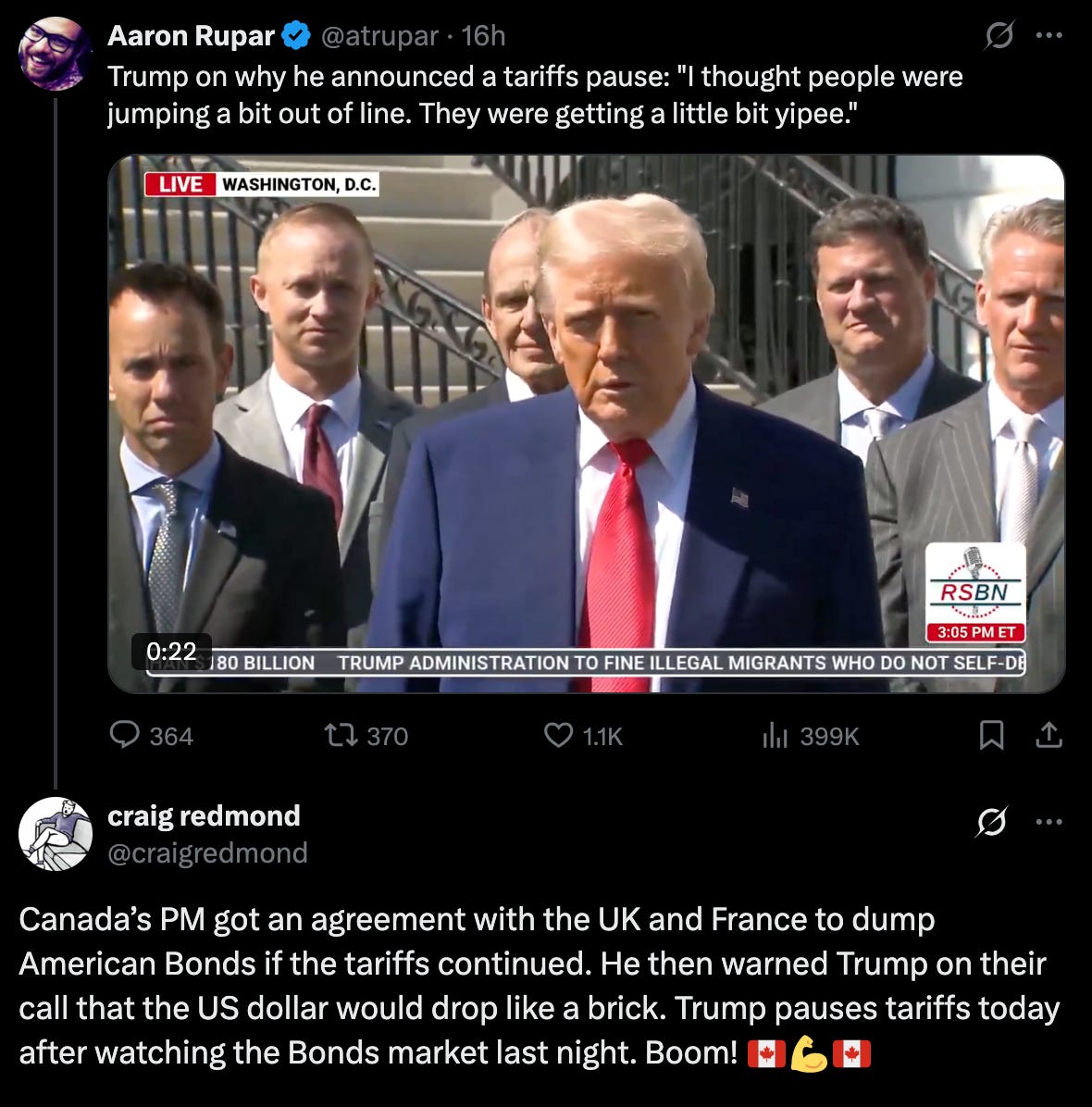
Giải thích ngắn về Trái phiếu Kho bạc và vì sao đòn xả bán toàn cầu có thể làm sụp đổ kinh tế Mỹ:
-
Trái phiếu Kho bạc Mỹ là gì? Chúng là giấy nợ do chính phủ Mỹ phát hành để vay tiền. Các quốc gia, ngân hàng và nhà đầu tư mua chúng, tức là cho Mỹ vay tiền. Mỹ hứa sẽ trả lại khoản vay kèm lãi suất theo thời gian (ví dụ: 10 năm).
-
Ai đang nắm giữ? Các quốc gia nước ngoài nắm giữ 8,5 nghìn tỷ USD nợ công Mỹ (tính đến năm 2025). Những người chơi lớn: Nhật Bản (>1 nghìn tỷ USD), Canada (350 tỷ USD), các quốc gia EU (tổng cộng 1,5 nghìn tỷ USD). Họ mua trái phiếu để cất giữ tiền an toàn và thu lãi ổn định.
-
Chúng ảnh hưởng đến Mỹ thế nào? Mỹ dùng tiền vay này để tài trợ cho mọi thứ — quân đội, An sinh Xã hội, cắt giảm thuế. Chi phí vay rẻ giúp kinh tế vận hành; chính phủ chi tiêu nhiều hơn số thuế thu được.
-
Điều gì xảy ra trong một đợt xả bán có phối hợp? Nếu các quốc gia như Canada, Nhật Bản và EU cùng bán trái phiếu (dù chậm rãi):
-
Trái phiếu tràn ngập: Quá nhiều trái phiếu xuất hiện trên thị trường cùng lúc.
-
Giá giảm: Cung vượt cầu đẩy giá trái phiếu xuống.
-
Lãi suất tăng vọt: Khi giá trái phiếu giảm, lợi suất (lãi suất) phải tăng lên để thu hút người mua.
-
-
Tác hại đối với Mỹ:
-
Việc vay tiền trở nên đắt đỏ: Lãi suất cao hơn đồng nghĩa với việc Mỹ phải trả nhiều tiền hơn để vay nợ.
-
Nợ chồng chất: Mỹ đã nợ 34 nghìn tỷ USD; các khoản vay đắt đỏ hơn khiến việc quản lý nợ trở nên khó khăn.
-
Đồng USD yếu đi: Bán trái phiếu đồng nghĩa với việc đẩy đồng USD ra khỏi tài sản, khiến giá trị đồng tiền sụt giảm.
-
-
Dẫn đến Suy thoái (Depression) ra sao?
-
Chi tiêu bị thắt chặt: Chính phủ cắt giảm chi tiêu khi chi phí vay vọt tăng — ít việc làm hơn, ít hỗ trợ hơn.
-
Doanh nghiệp kiệt quệ: Lãi suất cao bóp nghẹt các khoản vay; doanh nghiệp không thể mở rộng hay tuyển dụng.
-
Hàng nhập khẩu đắt đỏ: Đồng USD yếu làm hàng hóa nước ngoài (dầu mỏ, công nghệ) đắt hơn, đẩy lạm phát lên.
-
Thị trường sụp đổ: Tâm lý hoảng loạn bao trùm cổ phiếu và ngân hàng khi niềm tin vào nợ công Mỹ phai nhạt.
-
-
Hiệu ứng Domino: Mất việc làm, giá cả tăng vọt, tiền tiết kiệm bị bào mòn — những ngòi nổ kinh điển của đại suy thoái. Một cuộc xả bán chậm rãi, có phối hợp không phải là đòn tung tin đồn; đó là một cú đấm ngầm mà Mỹ phải mất NHIỀU NĂM mới hồi phục được.
BÌNH LUẬN VÀ PHÂN TÍCH CHUYÊN SÂU
-
Bản chất của đòn bẩy Trái phiếu (Treasury Bond Leverage): Trong các tranh chấp thương mại truyền thống, các quốc gia thường dùng thuế đối kháng (retaliatory tariffs). Tuy nhiên, thuế đối kháng tạo ra tác động hai chiều (gây tổn hại cho cả doanh nghiệp/người tiêu dùng trong nước). Bằng cách khai thác vị thế là chủ nợ lớn thứ 5 của Mỹ, Ottawa tận dụng gót chân Achilles của tài chính Mỹ: sự phụ thuộc vào dòng vốn ngoại hối để bù đắp thâm hụt ngân sách tài khóa.
-
Hiệu ứng lan truyền vĩ mô (Macroeconomic Contagion): Một sự sụt giảm nhu cầu mua Trái phiếu Kho bạc Mỹ từ các đồng盟 đồng loạt (Canada, Nhật Bản, EU) sẽ lập tức làm giảm giá trái phiếu, đẩy lợi suất (yields) tăng cao. Điều này trực tiếp kéo tăng lãi suất thế chấp nhà (mortgage rates) và chi phí vay vốn doanh nghiệp tại Mỹ, tạo ra áp lực tài chính tức thì lên Nhà Trắng.
-
Tính thực tế của chiến lược: Dù việc bán tháo trái phiếu trên quy mô lớn được ví như “vũ khí hạt nhân tài chính” (có thể gây tổn hại cho chính bảng cân đối kế toán của bên nắm giữ), việc sử dụng nó như một công cụ răn đe thầm lặng (quiet threat) kết hợp với các bước đi đàm phán kiên quyết cho thấy sự chuyển dịch từ xung đột thương mại thuần túy sang cuộc chiến đa tầng trên thị trường tài chính toàn cầu.
Carney’s Checkmate: How Canada’s Quiet Bond Play Forced Trump to Drop Tariffs
Carney, Japan And The EU proved America’s Idiot Emperor Has No Clothes
April 10, 2025
Let’s talk about the moment Donald Trump blinked. It wasn’t loud. It wasn’t a tweetstorm or a rally rant. When the tariff threats that had the world on edge—125% on China, 25% on Canada’s autos, a global trade war in the making—suddenly softened. A “pause,” he called it. A complete turnaround from the chest-thumping of the past week. And the reason? Mark Carney and a slow, deliberate financial maneuver that most people didn’t even notice: the coordinated Treasury bond slow bleed.
Trump CAVES: Orders 90 Day Pause on All Tariffs While Increasing China’s Tariff Rate to 125%

Trump’s Tariff Tantrum Ends in a Predictable Faceplant
This wasn’t about bravado. It was about leverage. Cold, calculated, and devastatingly effective.
Trump’s pause wasn’t because people were getting yippy…
Rewind a bit. While Trump was gearing up his trade war machine, Carney, Canada’s Prime Minister, wasn’t just sitting in Ottawa twiddling his thumbs. He’d been quietly increasing Canada’s holdings of U.S. Treasury bonds—over $350 billion worth by early 2025, part of the $8.53 trillion foreign countries hold in U.S. debt. On the surface, it looked like a safe play, a hedge against economic chaos. But it wasn’t just defense. It was a loaded gun.
Carney didn’t stop there. He took his case to Europe. Not for photo ops, but for closed-door meetings with the EU’s heavy hitters—Germany, France, the Netherlands. Japan was in the room too, listening closely. The pitch was simple: if Trump went too far with tariffs, Canada wouldn’t just retaliate with duties on American cars or steel. It would start offloading those Treasury bonds. Not a fire sale—nothing so crude. A slow, steady bleed. A signal to the markets that the U.S. dollar’s perch wasn’t so secure.

Here’s a brief explainer about Treasury Bonds and why Carney encouraged other countries to follow Canada’s lead, and why it worked:
How Treasury Bonds Work and Why a Global Sell-Off Could Tank the U.S.
- What Are Treasury Bonds?
- They’re IOUs the U.S. government issues to borrow money.
- Countries, banks, and investors buy them, lending cash to the U.S.
- The U.S. promises to pay back the loan with interest over time (e.g., 10 years).
- Who Owns Them?
- Foreign countries hold $8.5 trillion of U.S. debt (as of 2025).
- Big players: Japan ($1 trillion+), Canada ($350 billion), EU nations ($1.5 trillion combined).
- They buy bonds to park money safely and earn steady interest.
- How Do They Affect the U.S.?
- The U.S. uses this borrowed cash to fund everything—military, Social Security, tax cuts.
- Cheap borrowing keeps the economy humming; the government spends more than it collects in taxes.
- What Happens in a Coordinated Sell-Off?
- If countries like Canada, Japan, and the EU start selling bonds together (even slowly):
- Flood of Bonds: Too many bonds hit the market at once.
- Prices Drop: More supply than demand pushes bond prices down.
- Interest Rates Spike: When bond prices fall, yields (interest rates) rise to attract buyers.
- If countries like Canada, Japan, and the EU start selling bonds together (even slowly):
- Why Does This Hurt the U.S.?
- Borrowing Gets Expensive: Higher interest rates mean the U.S. pays more to borrow.
- Debt Snowballs: The U.S. owes $34 trillion already; pricier loans make it harder to manage.
- Dollar Weakens: Selling bonds means dumping dollars, so the currency’s value drops.
- How Does This Cause a Depression?
- Spending Dries Up: Government cuts back as borrowing costs soar—fewer jobs, less aid.
- Businesses Tank: Higher rates choke loans; companies can’t expand or hire.
- Imports Cost More: A weaker dollar makes foreign goods (oil, tech) pricier, jacking up inflation.
- Markets Crash: Panic hits stocks and banks as confidence in U.S. debt fades.
- The Domino Effect:
- Jobs vanish, prices spike, savings erode—classic depression triggers.
- A slow, coordinated sell-off isn’t a bluff; it’s a quiet gut punch that would take the US YEARS to recover from.
And here’s the kicker: Canada wasn’t alone. Japan, holding over $1 trillion in U.S. debt, signed on and started to sell those US Treasury bonds which scared Trump shitless. Key EU countries—collectively sitting on another $1.5 trillion—nodded in agreement. This wasn’t a bluff. It was a silent pact. A coordinated move to remind Trump that the free world doesn’t just roll over when he swings his tariff bat. Hurt us, Carney said, and we’ll hurt you—right where it counts.
The U.S. Treasury market is the backbone of the global economy. Foreign holders like Canada, Japan, and the EU keep it humming, financing everything from America’s military to its tax cuts. Start selling those bonds in unison, even gradually, and the yields spike. The dollar wobbles. Borrowing costs climb. Suddenly, Trump’s “beautiful” bond market—he bragged about it just yesterday—looks like a house of cards in a stiff breeze.

That’s the message Carney delivered in his call with Trump last week. No leaks on the exact words, but the outcome speaks volumes. Trump didn’t just pause the tariffs; he backpedaled hard. China’s still in the crosshairs—125% duties are no joke—but Canada? The EU? Japan? They’re off the hit list. For now, at least. Why? Because Carney’s play wasn’t noise. It was power.
Let’s be real: Trump’s spent years calling Canada a freeloader—remember his 2019 NATO jabs?—while ignoring the inconvenient truth. Canada’s $350 billion in U.S. debt isn’t charity. It’s a lifeline. Japan’s trillion-plus? Same deal. The EU’s pile? Ditto. These countries aren’t just buying bonds to be nice; they’re bankrolling the U.S. government. And when they threaten to pull the plug, even slowly, Washington listens.
This was the determining factor in Trump’s surrender. Not the public spats, not the retaliatory tariffs Canada slapped on U.S. autos (though those stung). It was the quiet, coordinated threat of a Treasury bond unwind that bent Trump’s knee. Carney didn’t need to shout. He didn’t need to posture. He lined up the free world—Japan, the EU, Canada in lockstep—and showed Trump the cliff’s edge. Strategic brilliance doesn’t get louder than that.
Carney also issued Canadian Treasury bonds in USD which was another brilliant way to strengthen Canada’s position and financial reputation. Little triggers and strategies you get when the world’s most respected economist is your PM…
When Trump announced his tariff “pause,” it wasn’t a victory lap. It was a concession. Carney moved markets without firing a shot. He gave Canada a seat at the power table and proved that global respect isn’t won with bluster—it’s earned with moves that hit where it hurts. Trump talks tough. Carney plays chess. And right now, the board’s his.
Want the raw data? Check the U.S. Department of the Treasury’s “Major Foreign Holders of Treasury Securities” report. Look at Canada’s holdings. Japan’s. The EU’s. Then ask yourself: who’s really holding “the cards.”
OH, and will Canada’s tariffs and countermeasures remain in place until after the election on April 28th? Yup.
Carney made sure to tell the world that despite Trump kissing our northern ring, we’re not negotiating shit until after the election. He also said we’re still moving away from our relationship with the US for greener, saner pastures.

That’s my PM.

