

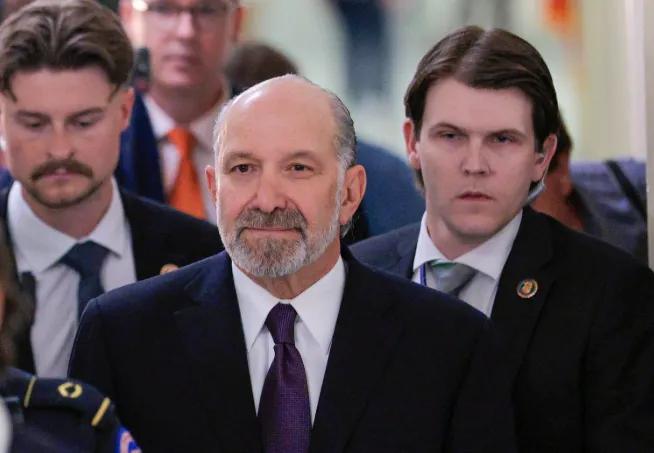
Hôm nay, Ủy ban Giám sát Hạ viện đã công bố toàn bộ biên bản lời khai của Howard Lutnick. Chúng tôi đã tiến hành điều tra ông này trong suốt nhiều tháng qua. Dưới đây là những gì ông ấy đã nói — và những gì các tài liệu ghi chép thực tế cho thấy.
ZEV SHALEV
NGÀY 14 THÁNG 5 NĂM 2026
The transcript runs 96 pages. Howard Lutnick sat in Room 2154 of the Rayburn House Office Building on May 6 and answered questions under penalty of 18 U.S.C. § 1001 — the federal false statements law. He used the phrase “meaningless and inconsequential” more than a dozen times. He called himself a man who avoids people without boundaries.
Narativ has been investigating Lutnick’s ties to Jeffrey Epstein, Tether, and the Russian financial network since before his confirmation. Here is where his sworn testimony meets our reporting.
1. THE HOUSE
Q: Did Epstein have any role in the sale of that property to you?
Lutnick: No. I bought my townhouse from someone named Charles de Gunzburg who owned it. So Epstein did not own the house.
When minority counsel pressed him on whether the house had previously been owned by Epstein, Lutnick spent twenty minutes threading language before landing here:
Lutnick: I don’t know and I don’t think I ever knew that Jeffrey Epstein owned the house that I bought.
What we reported:
Property records tell a different story. In 1988, SAM Conversion Corp. bought the townhouse at 11 East 71st Street using Leslie Wexner’s Columbus, Ohio address. Epstein was vice president. In 1992, SAM sold it to the 11 East 71st Street Trust for ten dollars — Epstein was the trustee. In 1996, the trust sold it to the Comet Trust for ten dollars. In 1998, the Comet Trust sold it to Howard Lutnick for ten dollars. Transfer taxes show the real price was $7.6 million. Lutnick took out a $4 million mortgage the same day.
An FBI whistleblower — a 32-year Cantor Fitzgerald veteran — told agents in February 2021 that Lutnick “bought the property for $10 through a trust,” that “LES WEXNER and EPSTEIN owned the building,” and Lutnick “bought it in a very roundabout way from EPSTEIN.”
Charles de Gunzburg may have been a name in the chain. The chain runs through Epstein’s trust.

BREAKING: Jeffrey Epstein Sold Howard Lutnick a Mansion for $10
2. THE E-MAILS
Lutnick: I do not recall ever having a phone call with Mr. Epstein, and I think I had one set of email interactions with Mr. Epstein personally that went — meaning four were written by me to him, but in one — effectively one conversation. I said A; he responded B; I wrote C; he responded D. And I think there were a total of four in one day once.
What we reported:
DOJ documents show some 250 emails between the Lutnick family and Epstein — covering business discussions, fundraiser plans, and correspondence that included an email listing the specific ages, names, and sexes of children coming to Epstein’s island. Lutnick’s testimony accounts for four.
Lutnick Admits Epstein Island Visit, Six Redacted Names Revealed, Trump Mentioned One Million Times in Unredacted Files, Melania Connection Exposed, and the DOJ Cover-Up Unravels
3. ADFIN: THE FIVE-DAY WINDOW
Q: Did you know that Mr. Epstein was an investor in this company AdFin?
Lutnick: No.
Q: When did you learn that he was an investor?
Lutnick: To the best of my knowledge, when these documents were released.
His lawyer added that the Cantor signing happened in spring 2013, not December 2012 as widely reported, and that Lutnick first heard about the investment from a pitch in May 2013.
What we reported:
Lutnick visited Epstein’s island on December 23, 2012. The AdFin stock purchase agreement is dated December 28, 2012 — five days later. Epstein signed for Southern Trust Company, Inc. — the same offshore entity at the center of Epstein’s financial architecture. Lutnick signed for CVAFH I LLC, a Cantor Ventures subsidiary. Whether the signing was December or spring, Lutnick and Epstein were co-investors in a startup through vehicles connected to the same offshore network within weeks of the island lunch Lutnick calls “meaningless and inconsequential.”
10 Ways Commerce Secretary Howard Lutnick is Compromised
PAID SUBSCRIBERS CAN ACCESS 5 OTHER PLACES LUTNICK’S TESTIMONY CONTRADICTS OUR INVESTIGATION PLUS READ THE FULL TRANSCRIPT.
4. THE NANNY
Q: You never encouraged any of the nannies that were under your employment to reach out to Mr. Epstein in any respect?
Lutnick: That’s correct. None.
Q: Do you possess any knowledge about it at all?
Lutnick: I have no knowledge about it at all.
Minority counsel then showed him the document — an email from Richard Kahn, Epstein’s accountant, with the subject line “Lutnick nanny,” attaching the resume of one of Lutnick’s nannies and arranging a meeting with Epstein. Lutnick said he couldn’t identify the person. He couldn’t confirm whether she had traveled to the island.
What we reported:
Epstein had no children. Epstein had no need for a nanny. His accountant circulated the resume of Lutnick’s nanny and arranged a meeting — months after Lutnick’s family boarded a boat to Epstein’s island.
Lutnick’s Nanny, Wexner’s Letter, Zorro Ranch and the $80 Trillion Heist
5. MAXWELL
Q: Have you ever met Ghislaine Maxwell?
Lutnick: I met her once.
Q: Can you explain when?
Lutnick: To the best of my recollection, I met her once. It was at a Rockefeller Institute fundraiser in New York City. My best recollection was she was a guest of Leon Black.
Q: What were the nature of your conversations?
Lutnick: Meaningless and inconsequential.
What we reported:
Two independent whistleblowers described the same events without prompting — La Dolce Vita Parties, high-profile celebrity fundraisers co-hosted by Maxwell and Sarah Ferguson, the Duchess of York. Lutnick gave Ferguson office space above Cantor Fitzgerald for a charity called Children in Crisis. Both whistleblowers named Lutnick as making “huge donations” they describe as fraudulent. Two people. Same parties. Same names. Same children’s charities. Lutnick said the total of his Maxwell contact was one inconsequential meeting.
6. THE BLACKMAIL WALKBACK
Congressman Ro Khanna walked Lutnick through a statement he made on the Pod Force One podcast in October 2025 — that Epstein was “the greatest blackmailer ever” and that was “how he made his money.”
Khanna: Did you believe that he engaged in blackmail?
Lutnick: It was just my speculation at the time.
Khanna: Is it still your belief?
Lutnick: No.
Khanna: Now you believe he didn’t engage in blackmail?
Lutnick Yes. I don’t believe he did.
Khanna: And why is that?
Lutnick: Because there have been people from the administration who have all of the details who have said so, and I credit what they’ve said.
Lutnick’s walkback is not only likely a lie, it also inadvertently confirms there is a cover-up by the regime.
Lutnick Was A Key Member of Epstein’s Network, CBS Becomes State TV, DHS Targets Critics, Iran Buildup and Canada Cuts Out the U.S.
7. THE FBI KNEW
Q: To your knowledge, were your interactions with Jeffrey Epstein ever discussed or examined in the course of your nomination or vetting process for your current position?
Lutnick: I don’t remember that, no.
What we reported:
On January 30, 2025, an FBI analyst ran Lutnick’s Cabinet security screening. It returned hits in two files: money laundering and the Epstein child sex trafficking investigation. An agent confirmed Lutnick had been accused of fraud and money laundering and confirmed the Bureau had not opened an investigation. About his appearance in the Epstein file: no response recorded.
The same 32-year Cantor veteran who told the FBI that Lutnick directed fraud at the firm also connected him to Liquid Funding Ltd. — Epstein’s $6.7 billion offshore vehicle, leveraged 180-to-1, holding toxic securities including repackaged Trump casino debt, at the center of the Bear Stearns collapse. FBI database checks returned 26 hits on Lutnick in New York alone, including a closed money laundering case and a RICO violations case, plus three Suspicious Activity Reports. The note at the bottom of the processing file: “Queries were not conducted on Epstein and Maxwell due to the sensitive nature of the case.”
Nineteen days after that screening, the Senate confirmed Howard Lutnick as Commerce Secretary, 51–45.
BREAKING: Jeffrey Epstein Sold Howard Lutnick a Mansion for $10
8. TETHER — THE QUESTION NOBODY ASKED
The committee spent four hours on Lutnick. They asked about the island, the massage table, the scaffolding, the nanny, the masks, the Frick Museum. They did not ask about Tether.
What we reported:
On October 6, 2025, Lutnick sold his stake in Cantor Fitzgerald to his four children. On October 7, Tether — the foreign stablecoin company headquartered in El Salvador, flagged by the UN, UK law enforcement, and the U.S. DOJ for financing sanctions evaders, weapons dealers, Hezbollah, North Korea, Iran’s central bank, and Asian trafficking syndicates — filed a credit document in New York showing it had lent an undisclosed sum to Dynasty Trust A. Dynasty Trust A’s four beneficiaries are Lutnick’s children. The loan is secured by all assets held by the trust, including more than half the equity in Cantor Fitzgerald.
On April 29, Senators Elizabeth Warren and Ron Wyden sent Lutnick eight questions and gave him until today — May 13 — to answer them. The fourth question: *”Did you agree, either explicitly or implicitly, to use your position as Commerce Secretary for the benefit of Tether in exchange for a loan facilitating your divestiture of Cantor Fitzgerald?”*
Lutnick testified May 6. The Senate’s deadline is today. The committee never asked.


